Former PhD student Dr. Adam Barno has just published a new study in Nature Communications, “Bacterial inoculation elicits changes to the coral epigenome”. Adam did his PhD in Prof. Raquel Peixoto’s lab, co-supervised by Prof. Alexandre Rosado. His study proposed that coral-associated microbes could alter the coral epigenome, the chemical marks that help control how genes are expressed. Until now, this idea had not been tested experimentally.
The team collected fragments of the coral Pocillopora verrucosa from the central Red Sea and kept them in aquaria for 28 days. During that time, they raised the water temperature from 27 °C to 33 °C and then let the corals recover. The corals were inoculated with a coral pathogen (Vibrio coralliilyticus), a coral probiotic (Cobetia sp.), or both. The pathogen changed DNA methylation in coral genes linked to immunity and to the symbiosis with their microalgae, and it led to more bleaching and tissue loss. When the probiotic was added together with the pathogen, these epigenetic changes did not appear, and the corals showed higher resilience and survival.
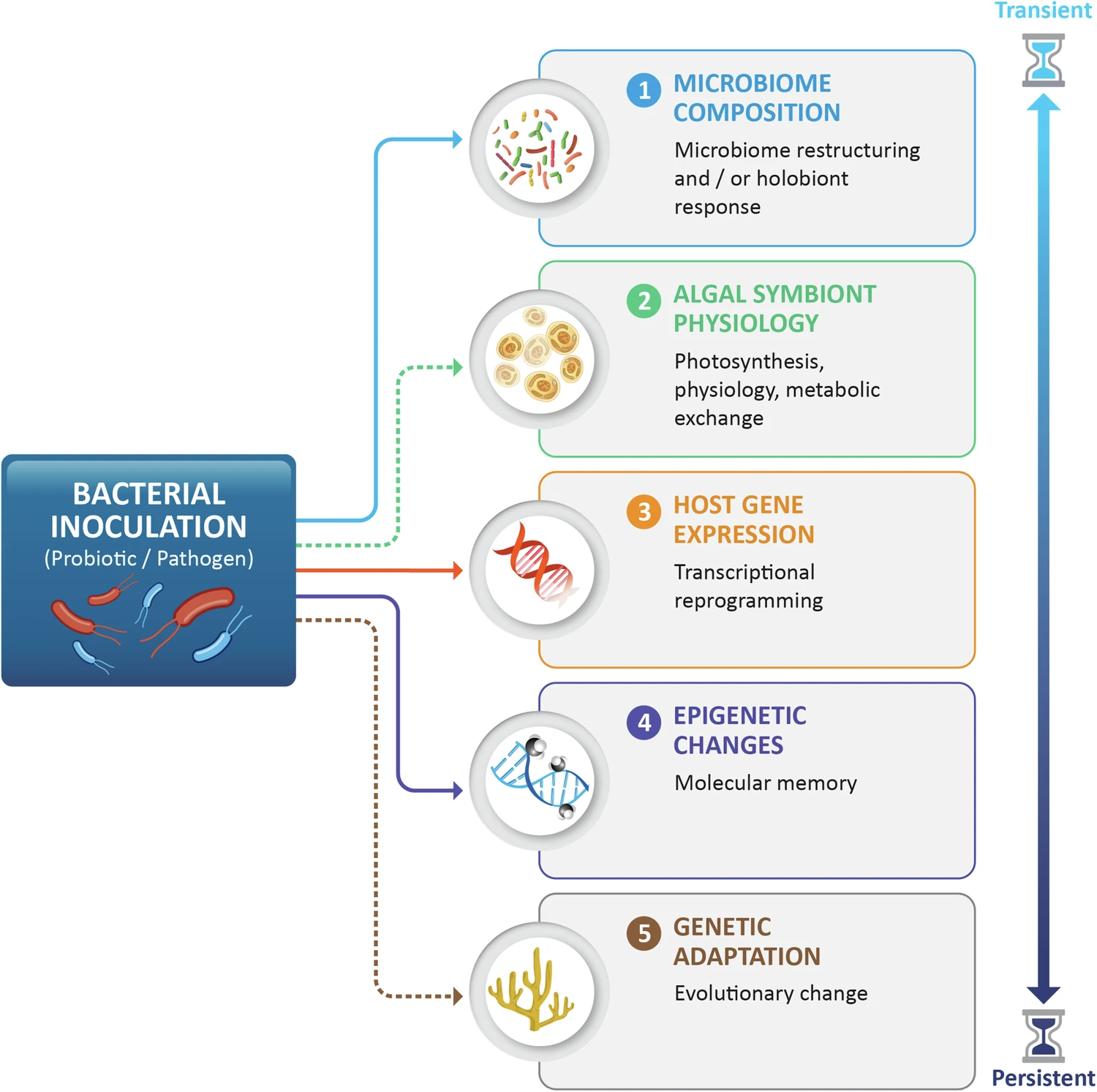
(Source: Barno et al., 2026)
These results suggest that changes in the coral microbiome can leave a longer-lasting mark on the host through its epigenome. This opens new possibilities for using probiotics to protect corals under heat stress. Congratulations, Dr. Adam, and to all co-authors! The article is open access
here.